Our Location
304 North Cardinal St.
Dorchester Center, MA 02124

304 North Cardinal St.
Dorchester Center, MA 02124


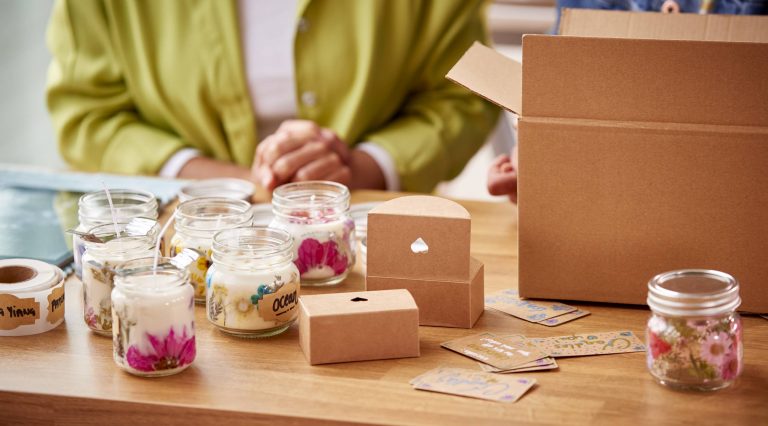
Craft candle making is often associated with aesthetics, but it’s actually a very deliberate practice that involves careful observation and time. For example, wax can’t be heated too much or too little, fragrances can’t be added too early or too late, and pouring temperatures can be too hot or too cold. The degree to which factors like these affect the candle making process is what makes it quietly deliberate. Every time you pour a candle, you’re forced to pay attention and adjust, rather than try to control things. It helps you develop a work pace and problem solving approach that gradually influences the way you think about work in general.
Wax has memory, so it retains characteristics of past heating and cooling, pouring and moving. Different fragrance oils distribute differently throughout the melted wax. Different wicks burn differently in different jars. So you need to repeat and reflect, rather than rush. It teaches you to respect your limitations. I think having constraints actually clarifies your ideas and helps you make decisions. You make trade-offs between too much and too little, rather than going all out.
Part of this is learning from your mistakes. If the surface of your candles is bumpy, or the burn time is off, or the fragrance throw is weak, that’s all data. Each time you make a candle, you get information about the timing, temperatures and proportions of ingredients that you used. The craft rewards people who take the time to try and interpret this data. As you gain experience, you learn to make changes on the fly, and it feels good to know that you’re in control of this small system. But I think what you’re really developing is the ability to respond to changing conditions and unexpected outcomes. It’s not really about mastering a set of rigid protocols. This attitude actually helps you avoid perfectionism. You’re more concerned with optimizing your system than trying to achieve a standard.
The steps involved in making a candle are so repetitive and straightforward that you’re able to focus. In fact, the process of pouring and waiting and pouring and waiting actually seems to induce a flow state. You’re fully engaged in the moment and able to concentrate in a way that feels meditative and fulfilling. I think this is part of why people enjoy making candles. You make something you can use and admire, but the act of creating it feels enjoyable and valuable in itself. This is why I think the rewards of craft candle making persist even after you have all the candles you need.
It’s a way to engage in focused, physical labor in a world where it’s increasingly easy to let someone else do it for you. It’s a way to feel patient and responsible, and to appreciate the value of process over outcome. And each candle you make is a tangible reminder of this mindset, which is shaped by the work itself rather than your motivations for doing it.